
LiveOps
Today’s orders, revenue, payments and fulfilment events brought together in one live operational feed.
H the cofounder
AI commerce intelligence platform
We designed and built H to connect a commerce team’s operations, customers, products, logistics, marketing and finance, then turn the data into decisions a founder can act on.
Project frame
Our role
Product strategy, UX/UI, full-stack engineering and launch
Audience
D2C founders, commerce operators, marketers and finance teams
Product
Responsive SaaS workspace with live third-party integrations
Status
Live product, currently onboarding brands in early access
The challenge
Shopify knew the orders. Razorpay knew the settlements. Ad platforms claimed conversions. Couriers knew delivery and RTO. Klaviyo knew retention. Each tool was useful, but no tool held the full commercial truth.
Founders were still stitching exports together at midnight, comparing different definitions of revenue and reacting after the moment to act had passed.
The brief was not “build another dashboard.” It was to create an AI cofounder that reconciles the stack daily, explains what changed and keeps the next action close to the evidence.
Shipped product scope
The live product is designed to make a large integration surface feel small: connect the tools, let H reconcile them, and read every module from one workspace.
From Shopify connection to first dashboard
Apps connected across the commerce stack
Purpose-built operational dashboards
Explicit Shopify action scopes
11 dashboards
One workspace, eight capabilities
Eleven dashboards turn the connected stack into role-specific views without splitting the underlying truth.
Today’s orders, revenue, payments and fulfilment events brought together in one live operational feed.
Meta Ads, Google Ads and Klaviyo performance read against delivered revenue, not just platform-reported conversions.
Four linked views for Customers, Products, Demographics and Logistics, reconciled from the same commerce data.
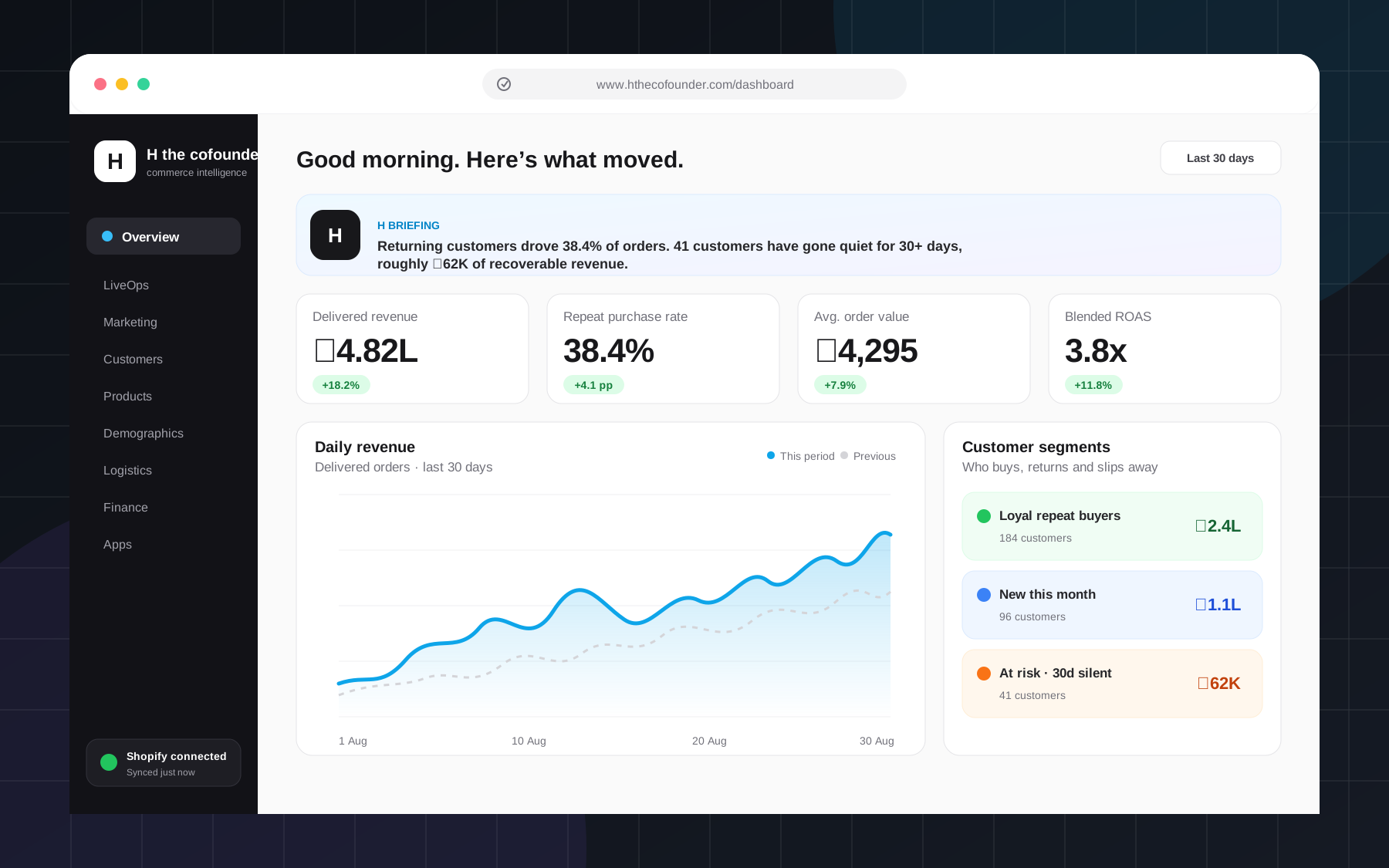
Loyal, new and at-risk cohorts, paired with the rupee value of retaining or winning each audience back.
NDR queues, courier-level SLA, delivery performance, RTO and COD-versus-prepaid splits across four courier platforms.
Recognised versus delivered revenue, Razorpay settlements, fees, unit economics and a complete P&L.
An AI cofounder that reads the selected Shopify period, then explains what moved and why in plain language.
Recent Gmail and Drive activity inside H, including the ability to reply without leaving the workspace.
How the system works
The product architecture was designed around a simple mental model rather than the shape of any individual vendor API.
Pull the approved commerce, payments, marketing, courier and workspace data into H.
Normalize the sources around delivered revenue, customers, products and fulfilment.
Surface live views, cohorts and an H briefing that tells the founder what changed and why.
Decision layer
Delivered revenue, not an ad platform’s self-reported conversion, is the shared commercial reference point.
Integration layer
Connectors are not treated as isolated add-ons. Each connection keeps the relevant H modules in sync.
Orders, customers, products and inventory, reconciled daily into every dashboard.
Payments, fees, refunds and bank settlements reconciled inside Finance.
Campaign, ad-set and creative performance on a dedicated Meta Ads dashboard.
Spend, ROAS and campaign performance displayed beside delivered revenue.
Flows and campaigns measured against the revenue they actually drive.
RTO rate, NDR queue, delivery SLA and the COD-versus-prepaid split.
Delivery, NDR, RTO and SLA analytics from Shipmozo shipments.
Surface and Express statuses, NDR and RTO tracked in the Logistics module.
RTO rate, NDR queue and delivery performance across NimbusPost couriers.
Recent Gmail, in-product replies and visibility into the latest Drive files.
Onboarding UX
Shopify takes about four minutes to connect; a courier or ad account takes roughly two. We turned credentials and API settings into short, platform-specific tutorials.
The guided tutorial points the user to the exact settings screen inside the connected platform.
For Shiprocket, a fresh API user prevents the main dashboard login from being signed out.
The user verifies that the new API user is active before sharing only the credentials H needs.
H completes the connection and starts reconciling the relevant modules. Shiprocket re-authentication is handled every 10 days.
Trust architecture
H handles live revenue data, so security had to be a visible product experience, not a paragraph hidden in legal copy.
Analytics remains read-only. Shopify write scopes are requested only for explicit actions the user chooses and approves.
Access tokens are encrypted at rest, travel only over TLS and are re-authenticated without making the user repeat setup.
Disconnecting an app kills access with the token. Teams can export or delete their data at any point; deleted data is not kept in an archive.
The five explicit actions
H never books, cancels or edits a shipment, and it never edits an existing order.
Launch model
H is free while the first brands are onboarded in early access. The live landing page makes the post-launch packaging clear before billing begins.
Free
Every new workspace starts here
Silver
After launch · free during early access
Platinum
Annual billing
Pricing and early-access status reflect the live H landing page at the time this case study was updated.
The outcome
Stalite took H from product framing through interaction design, integration architecture and launch, building the operational workspace, the onboarding system and the public product story as one coherent experience.
Build with Stalite
We design and engineer custom web applications around the decisions your users actually need to make.